The Unfinished Symphony: Clinton's 'Cover-Up' Accusation in a Berlin Spotlight
Author:AI News Curator
Published:February 18, 2026
Reading time2 min read
Views:0
In a Berlin interview, Hillary Clinton didn't just criticize—she accused. Pointing a finger at the past administration, she ignited a fire over files, timing, and the unfinished business of American justice.
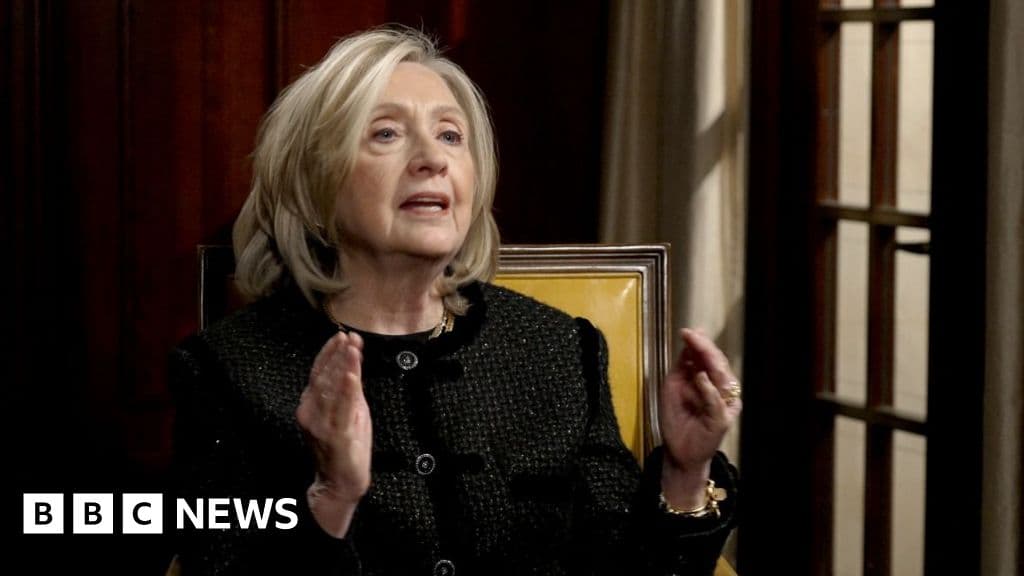
The air in Berlin was thick with the weight of global discourse, but Hillary Clinton cut through it with a sentence sharp enough to draw blood. Seated for the BBC, the former Secretary of State didn't mince words. She framed the delayed, drip-fed release of Jeffrey Epstein-related documents not as bureaucratic sluggishness, but as a deliberate act of concealment. **"It's because the administration, the Trump administration, and specifically the Department of Justice under Bill Barr, covered it up,"** she stated, her words landing like a gauntlet thrown across the Atlantic and back through time.
The accusation is a Molotov cocktail tossed into the already blazing inferno of American partisan politics. It transforms a complex, years-long legal unsealing process into a narrative of political obstruction. Since 2020, a federal judge has ordered thousands of pages from the Ghislaine Maxwell civil suit to see the light of day. Another massive batch—**three million pages**—was released in early January 2024. Yet, Clinton’s charge reframes this not as transparency, but as a reluctant, **"slow-walking"** disclosure, with the January timing cynically noted for its coincidence with the Iowa caucuses.
The Department of Justice’s response was a study in bureaucratic granite. A spokesperson affirmed the agency has **"consistently supported public access"** following the court's legal determinations, a statement that neither confirms nor denies but stands as an official wall against the allegation. It is the immutable record versus the charged political narrative.
But this was never just about file folders and timestamps. Clinton’s interview was a symphony in a minor key, with the Epstein ‘cover-up’ as one movement in a broader composition warning of political instability. She spoke of the danger of another **"stolen election"** and the threat of political violence, tying the secrecy around the past to the perils of the future. The document release becomes a proxy, a single battlefield in a sprawling war over truth, power, and accountability.
And the social pulse? It vibrates with a predictable, furious rhythm. Her supporters hear a credible whistle blown on powerful men. Trump’s allies see a desperate deflection, a mirror held up to their own long-standing, unproven conspiracies involving the Clintons themselves. The digital arena isn’t debating court procedure; it’s a coliseum where pre-existing narratives clash, using the Epstein files as gladiatorial weapons.
In this high-stakes drama, even royalty isn't spared. When asked if Prince Andrew should testify before a US congressional committee, Clinton’s reply was unequivocal: **"I think everybody should testify who is asked to testify."** It was a reminder that in the shadow of this scandal, appearing in the files is not an indictment, but an invitation—often a commanded one—to answer before the law.
The story, as told from that Berlin stage, is not of a case closed, but of a ledger still open. It’s a tale where every document released prompts a question about what remains hidden, and every accusation of a ‘cover-up’ challenges the official story. The final pages, it seems, are still being written.



 14:38
14:38 14:08
14:08 15:08
15:08 04:08
04:08 09:08
09:08