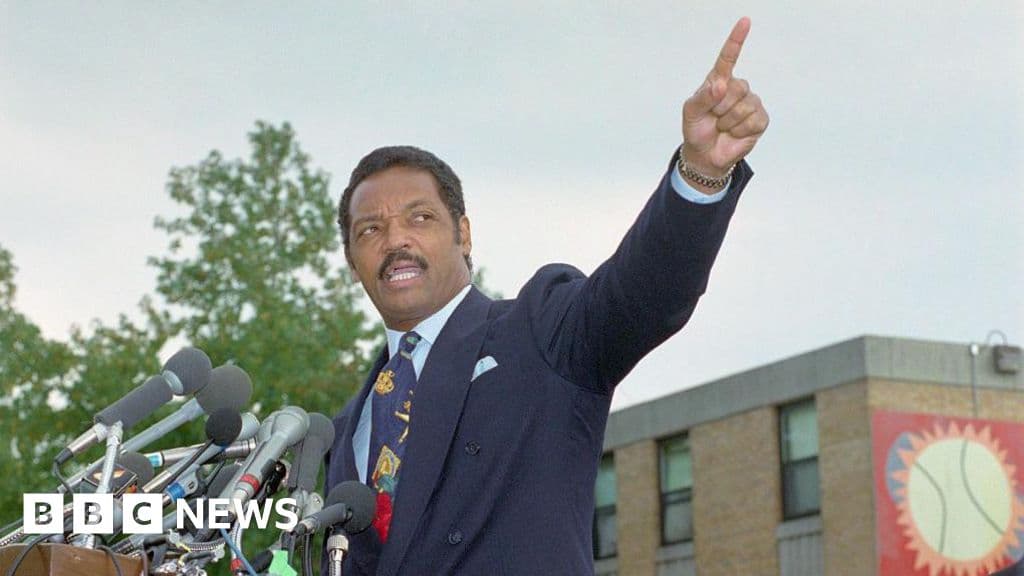
His life was a motion picture of American struggle. From a balcony in Memphis to the world stage, the photographs of Jesse Jackson map a nation's conscience.
The sky over Memphis was a rust-colored bruise on the evening of April 4, 1968. The air on the balcony of the Lorraine Motel was thick with the acrid scent of history turning violent. In the chaotic moments after the crack of a rifle, a young man in a turtleneck and leather jacket stood over a pool of blood, his face a mask of anguish and stunned disbelief. The man was Reverend Jesse Jackson. The blood was Martin Luther King Jr.’s.
That image, captured by a photographer’s flash, is not just a photograph. It is a wound. It is the precise moment the baton of the Civil Rights Movement, slick with gore, was passed—not by ceremony, but by catastrophe. It frames the beginning of a story that would stretch for over half a century, the story of a man who would learn to channel that searing grief into a formidable, complex, and often contentious force of nature.
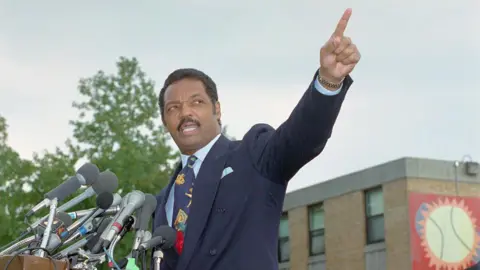
Jackson did not just mourn; he built. From the ashes of that motel balcony, he forged his own path. In 1971, he founded Operation PUSH (People United to Serve Humanity), a Chicago-based engine for economic justice that demanded corporate America open its doors. The photographs from this era show a different Jackson: no longer the stricken lieutenant, but a charismatic, finger-jabbing orator in three-piece suits, holding rallies that pulsed with the energy of a revival tent. He was building a base, his own constituency.
That base became the fuel for a political earthquake. In 1984, he launched a quixotic campaign for the Democratic presidential nomination. The political establishment sneered. The media caricatured. But in church basements and union halls, Jackson preached a gospel of a "Rainbow Coalition"—a poor people’s campaign of Blacks, whites, Latinos, and Asians. He didn’t win, but he proved a point: there was power in the margins.
Four years later, in 1988, he proved that power could shake the center. The visuals from that campaign are iconic: Jackson, now a globally recognized figure with streaks of grey in his hair, addressing thunderous crowds. He won 11 primaries and caucuses, including Michigan, and came in a strong second to Michael Dukakis. The picture of him standing on a stage, one fist raised in victory, was a seismic image for Black America. It was the picture of a door being kicked in.
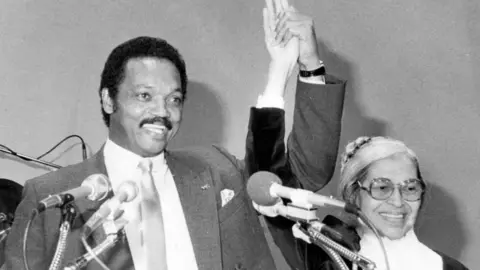
His authority was not confined to the ballot box. He carried it into the world’s danger zones, acting as a freelance diplomat when official channels froze. In 1984, he flew to Damascus and secured the release of captured U.S. Navy pilot Lt. Robert Goodman from Syria, returning home to a hero’s welcome. He would later negotiate the release of hostages from Iraq and Kosovo. These missions, captured in newsreels and photos, cemented his image as a man who could operate where governments could not—a pastor with a passport and unparalleled nerve.
The later frames of his life show the evolution from fiery outsider to embedded elder statesman. There he is in 1993, alongside a beaming Nelson Mandela, bridging struggles across oceans. In 2000, President Bill Clinton places the Presidential Medal of Freedom around his neck—an official embrace of a once-radical legacy. And in 2008, a powerful, silent image: an elderly Jesse Jackson, tears streaming down his face in a Chicago park, as the news declares Barack Obama the first Black president of the United States. It was the closing of a circle he helped draw.
The final chapters, documented in recent years, show a fighter facing a different kind of battle. Diagnosed with Parkinson’s disease in 2017 and prostate cancer in 2024, public appearances became rarer, his once-protean frame steadied by a cane. Yet, even in 2020, he traveled to Minneapolis after the murder of George Floyd, a testament to a resilience that refused to be framed by illness.
To scroll through the photographs of Jesse Jackson is to watch the 20th and 21st centuries develop in real-time. They are more than a record; they are a argument. An argument about power, voice, and the long, unbroken thread of justice that runs from a balcony in Memphis to every arena he ever dared to enter. The frame holds a fighter. The story is America’s.



 14:30
14:30 14:00
14:00 15:00
15:00 04:00
04:00 09:00
09:00