Metal Dragons Dance: The New Year's Robotic Revolution
Author:AI News Curator
Published:February 18, 2026
Reading time2 min read
Views:0
China's 2024 Spring Festival Gala witnessed not just celebration, but a declaration: humanoid robots, performing advanced martial arts, have moved from labs to the living room.
The stage lights dimmed, leaving the deep red and gold backdrop of the **CCTV Spring Festival Gala** to glow like embers. For a moment, the audience held its breath—the same breath held by hundreds of millions across China. Then, they emerged. Not dancers, not acrobats, but a phalanx of **humanoid robots**. Their movements began not with a mechanical jerk, but with the slow, deliberate flow of **Tai Chi**. In that moment, tradition didn't meet the future; it was reprogrammed by it.
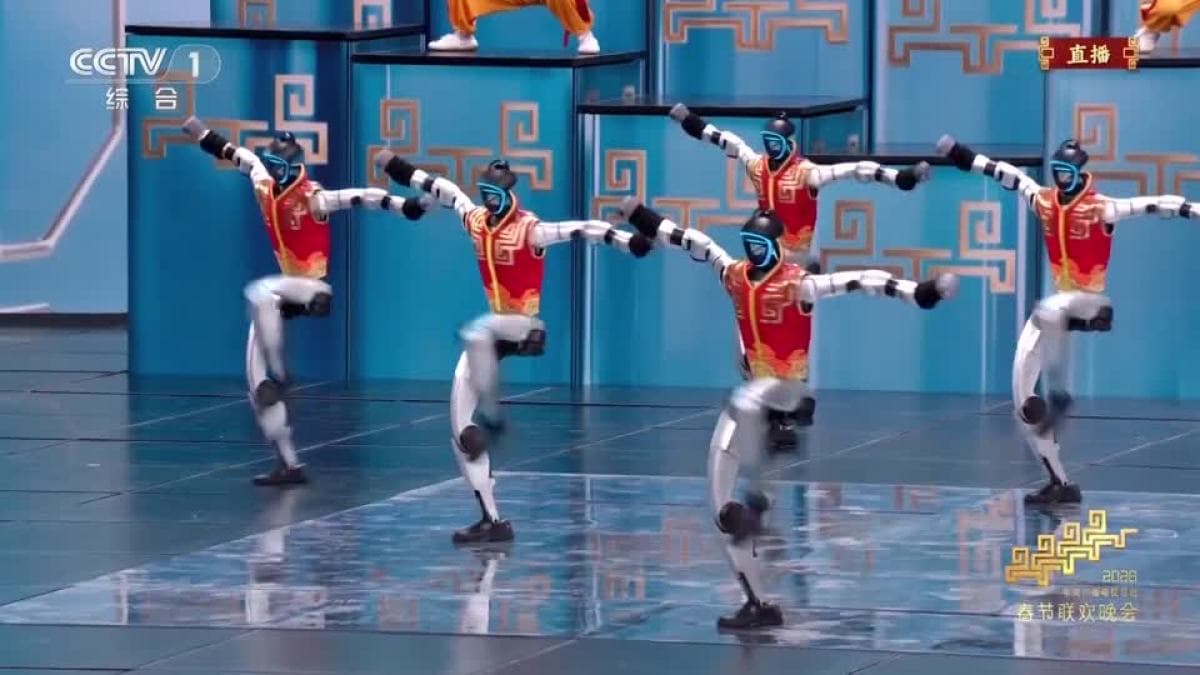
This was the 2024 Gala's silent thunderclap. Where last year's robots twirled handkerchiefs in a quaint display, this year's models—**Xiaomi's CyberOne, Fourier Intelligence's GR-1, and OrionStar's Walker S**—executed a sophisticated, coordinated martial arts routine. Their hands traced arcs through the air with a fluid grace that belied their silicon and steel origins. They shifted stances, balanced on one leg, and moved in a harmony that spoke of immense computational power whispering commands to servo motors. This was no simple demo; it was a **narrative of prowess**, timed perfectly for the **Year of the Dragon**—a symbol of strength, innovation, and auspicious fortune.

*Humanoid robots from Chinese tech firms perform a coordinated martial arts routine at the 2024 CCTV Spring Festival Gala. (Illustrative Image)*
The segment was a masterclass in **soft power engineering**. Each synchronized gesture was a data point proving a thesis: China has achieved significant, demonstrable leaps in robotic **balance, dynamic bipedal locomotion, and AI-driven motion control**. These weren't just machines bolted to factory floors; they were potential companions, future responders, and yes, performers, capable of intricate physical tasks within human spaces. The message was woven into the choreography itself: technological advancement is our cultural offering, our modern-day dragon dance.
By the following year, the ambition had exploded. As reported, the 2026 gala featured robots from firms like **Unitree and Magiclab** performing "the world’s first continuous freestyle table-vaulting parkour" and "aerial flips"—stunts that would challenge elite human athletes. Deals with robotics firms for the show were reportedly worth about **100 million yuan ($14 million)**, underscoring the state's financial and symbolic investment in this sector [Al Jazeera](https://www.aljazeera.com/). The progression from flowing Tai Chi to airborne backflips in just two years frames a relentless trajectory.
Ultimately, the Gala stage became a proving ground. The applause that followed the 2024 performance was for more than a clever show. It was an acknowledgment of a threshold crossed. The humanoid, long a fixture of science fiction, has been patiently assembled in Chinese R&D labs. That night, it bowed before the nation—not as a clumsy prototype, but as a poised entity ready to step out of the celebratory light and into the unfolding story of the century.



 14:31
14:31 14:01
14:01 15:01
15:01 04:01
04:01 09:01
09:01