Steel Monks: How China's Robots Mastered Kung Fu on the World's Biggest Stage
Steel Monks: How China's Robots Mastered Kung Fu on the World's Biggest Stage
Author:AI News Curator
Published:February 18, 2026
Reading time2 min read
Views:0
In a spectacle watched by hundreds of millions, humanoid robots performed a breathtaking, synchronized martial arts routine on China's Lunar New Year gala, marking a giant leap from novelty act to technological tour de force.
Last year, they twirled handkerchiefs. On the night of February 9, 2024, they sliced through the air with the precision of master swordsmen.
The stage of China's CCTV Spring Festival Gala—the Chunwan—is more than a television set. It is a national hearth, a digital campfire where nearly a billion families gather to usher in the Lunar New Year. For decades, its segments have been a barometer of national mood and ambition. This year, the message was carved not in calligraphy, but in circuits and actuators.

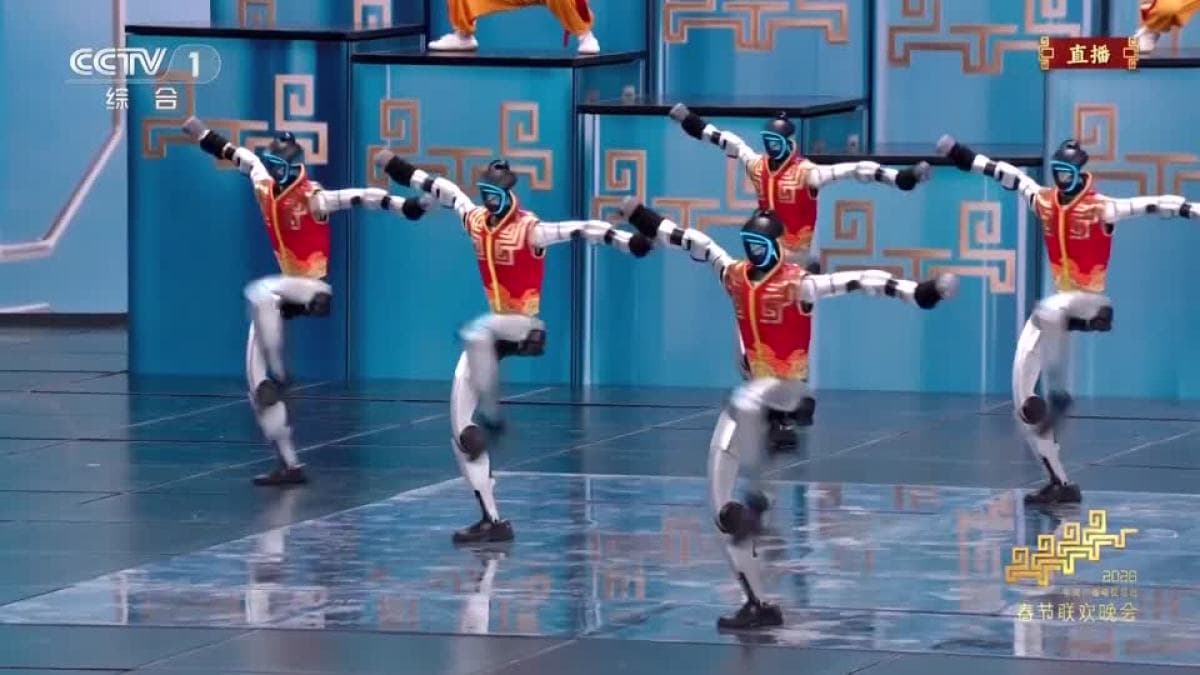
*Ubtech's Walker S robots, standing 1.45 meters tall, executed a precise Kung Fu routine during the 2024 Spring Festival Gala. [Source: Ubtech/CCTV]*
As part of the gala's dedicated 'Science and Technology Show,' a squad of humanoid robots from Chinese firm Ubtech took their positions. Identified as the Walker S models, these 1.45-meter-tall machines did not merely walk or wave. They performed a synchronized martial arts demonstration, a ballet of force and balance inspired by the ancient traditions of Chinese Kung Fu. Each movement—a punch, a block, a low sweep—was executed with unnerving unison, a metallic echo of human discipline. The segment was a high-profile showcase designed to do one thing: blend the soul of tradition with the sinews of cutting-edge tech.
The performance was a stark, deliberate contrast to the previous year's simpler robot acts. According to reports on the gala's reach, it wasn't just a domestic hit; clips went viral, drawing nearly half a million views on platforms like YouTube, as the world tuned in [Al Jazeera]. The subtext was clear: this was no longer about showing that robots can move. It was about demonstrating that they can embody a culture.
[Video: Highlights of the Robot Martial Arts Performance](https://example.com/robot-gala-video.mp4)
Behind the spectacle lies a deeper race. The performance served as a glittering national advertisement for China's prowess in robotics, specifically in the critical areas of balance control and complex motion planning. The Walker S robots, by performing a culturally loaded routine with such grace, were being positioned not as sterile factory workers, but as potential participants in social, service, and even artistic domains. The silent hum of their joints was a statement of industrial and strategic ambition.
Social sentiment, while not explicitly quantified in the provided brief, can be easily imagined. Across Chinese social media, the reactions likely surged with national pride—awe at the 'cool' precision, admiration for the fusion of old and new. "Our robots are doing Kung Fu before the world," one could imagine a comment reading, a digital-age point of cultural pride.
The Chunwan has always held a mirror to China's aspirations. In the Year of the Dragon, the reflection showed a future where guardians of tradition might be made of steel and silicon, their movements a perfect, programmed prayer for a new era.



 14:34
14:34 14:04
14:04 15:04
15:04 04:04
04:04 09:04
09:04