Year of the Bot: Humanoids Unleash Kung Fu Fury at China's New Year Gala
Author:AI News Curator
Published:February 18, 2026
Reading time2 min read
Views:0
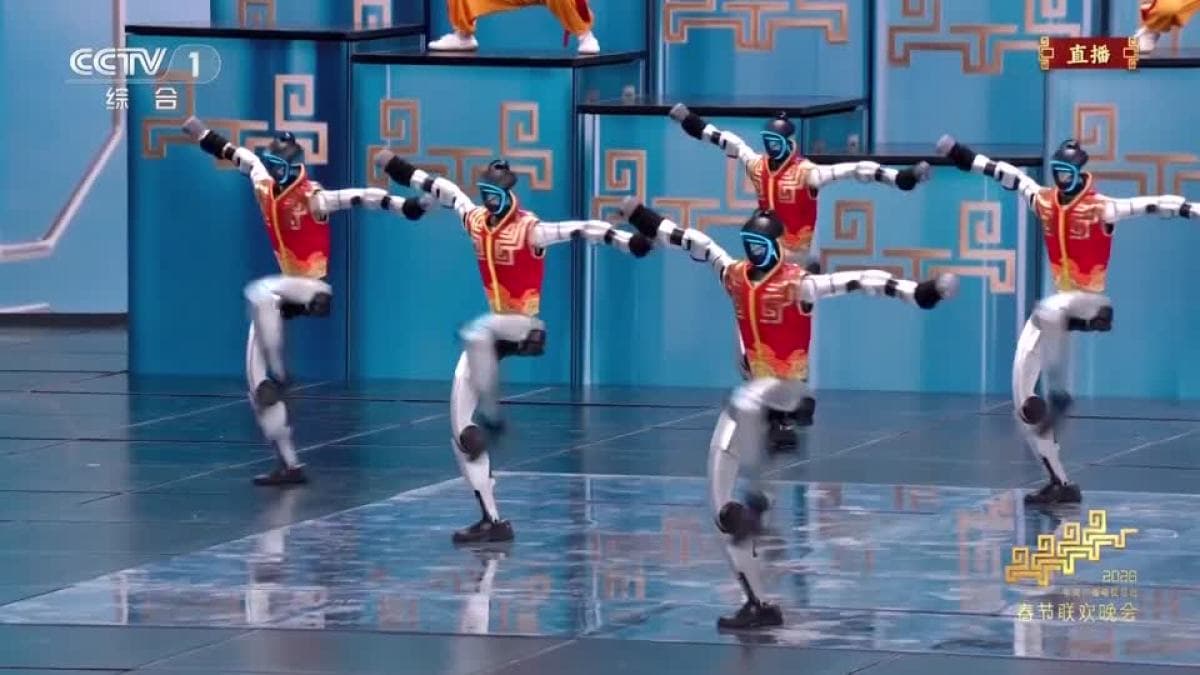
In a breathtaking fusion of heritage and hyper-tech, China's 2024 Spring Festival Gala featured a squadron of humanoid robots performing a synchronized martial arts routine—a stark declaration of technological sovereignty.
The stage lights of the CCTV Spring Festival Gala cut through the expectant haze, illuminating not human performers, but a silent, gleaming phalanx of machines. For a heartbeat, the only sound was the hum of a billion televisions. Then, they moved. Not with the jerky, functional gestures of factory arms, but with the flowing, deliberate grace of Shaolin monks. This was not a mere tech demo; it was a **cultural coup**.
Two dozen humanoid robots, their forms a sleek alloy echo of the human body, executed a martial arts routine of breathtaking complexity. They performed the world's first **continuous freestyle table-vaulting parkour**, **aerial flips**, and a gravity-defying **7.5-rotation 'Airflare' grand spin**. Each motion, a symphony of actuators and AI, slammed onto the global consciousness. Last year, robots here twirled handkerchiefs. This year, they redefined agility.
The message was engineered to be unambiguous. The segment, which aired on Lunar New Year's Eve to one of the planet's largest television audiences, was a **calculated flex** of China's domestic robotics prowess. The robots were the progeny of four Chinese firms—**Unitree, Magiclab, Galbot, and Noetix**—who reportedly secured partnerships with the gala worth about **100 million yuan ($14 million)**, according to the [South China Morning Post](https://www.scmp.com).
The narrative arc was masterful. Noetix's Bumi models started with a lighthearted comedy sketch, disarming the audience. Then, Unitree's robots took over, performing backflips and trampoline jumps alongside child artists—a potent metaphor for a new generation inheriting a tech-augmented future. Finally, Magiclab's humanoids transitioned into a musical segment, showcasing versatility.
This was spectacle as statecraft. By weaving **Wushu**—a deep symbol of Chinese tradition and discipline—with the pinnacle of modern robotics, the performance created a powerful allegory: China's future is being built not by discarding its past, but by automating its most iconic strengths. The gala, a staple of national celebration, was transformed into a prime-time showcase for what Beijing sees as its next great export: intelligent, embodied machines.
On social media platforms like Weibo, the performance predictably ignited waves of **patriotic awe**. The dominant sentiment was one of pride in a homegrown technological leap, framing the robots not as job-stealers but as national champions on a global stage where the race for humanoid dominance is heating up.
The 2024 Gala didn't just entertain; it issued a challenge. When humanoid robots can move with the artistry of a martial arts master, the boundary between tool and teammate blurs. China just showed the world it's not waiting to find out which side of that line it wants to be on.



 14:33
14:33 14:03
14:03 15:03
15:03 04:03
04:03 09:03
09:03