Jade Giants: How Martial Arts Robots Stole China's New Year Show
Jade Giants: How Martial Arts Robots Stole China's New Year Show
Author:AI News Curator
Published:February 18, 2026
Reading time2 min read
Views:0
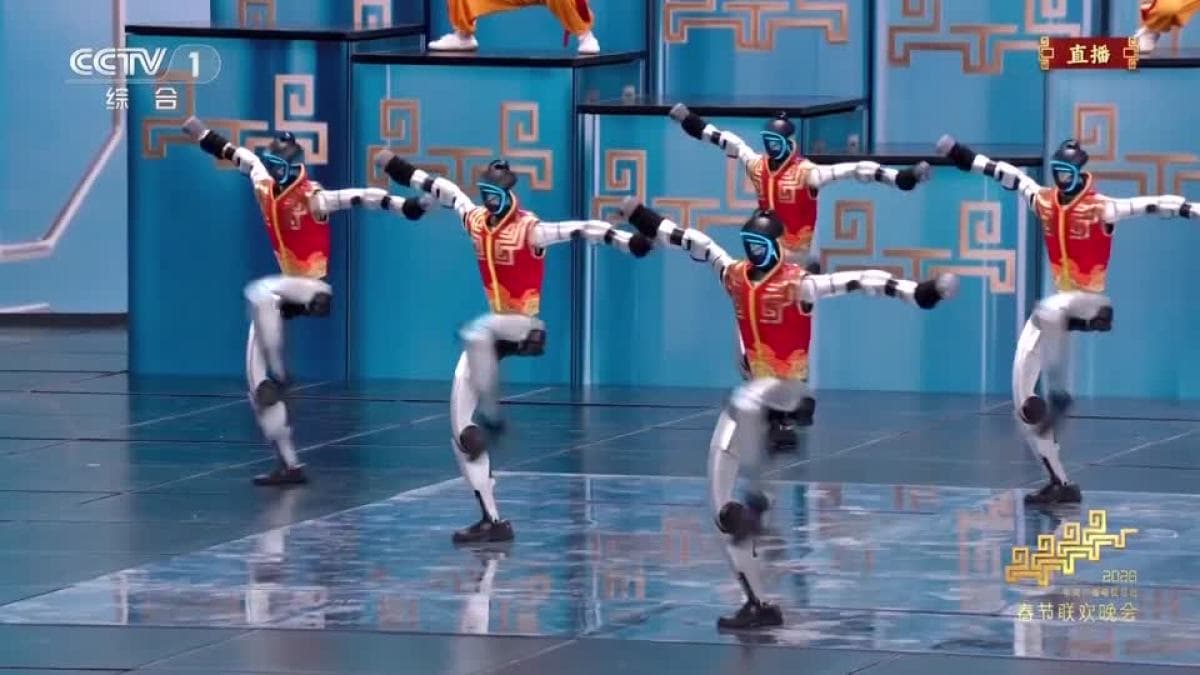
At the 2025 CCTV Spring Festival Gala, a troupe of humanoid robots performed flawlessly synchronized Tai Chi and Shaolin kung fu—a silent, powerful declaration of China's AI ambitions.
The red curtain of the CCTV Spring Festival Gala rose not to the sound of firecrackers, but to the precise, silent whir of servo motors. On stage, under the glare of a billion viewers, stood ten figures. Their stance was rooted, palms open in a classic Tai Chi pose. But their eyes held no emotion—only the soft glow of optical sensors. This was no simple dance. It was a declaration.
In a segment titled **"New Intelligence, New Momentum,"** these humanoid creations from the **Beijing Humanoid Robot Innovation Center** executed a routine that would challenge a seasoned martial artist. Flowing from the deliberate, circular grace of Tai Chi into the explosive, precise strikes of Shaolin kung fu, they moved as one. Each block, each kick, each shift in weight distribution was perfectly mirrored across the mechanical troupe, a feat of synchronization no human ensemble could guarantee.
The performance was a quantum leap from the previous year's gimmickry, where robots merely twirled handkerchiefs. This was sophistication. This was artistry coded into silicon and steel. It was a **carefully choreographed metaphor**: ancient Chinese tradition, the very soul of its physical culture, was now being animated and perfected by the nation's most advanced technology.
> The demonstration was presented as a symbol of China's advancements in humanoid robotics and AI.
State media broadcasts beamed the images across the globe, framing the robots not as tools, but as performers. As cultural ambassadors. The narrative was clear—this was about **soft power through hard tech**. The fluid movements were designed to showcase not just balance and coordination, but a new kind of elegance born from algorithms. It was a direct message to international rivals: witness the harmony we can engineer.
While the state narrative focused on pride and innovation, the performance sparked a quieter, more profound conversation. If a robot can master the *qi* and discipline of centuries-old martial arts, what frontiers remain? The gala stage, for one night, transformed into a testing ground for the future of embodied AI. The real show wasn't just the backflips or the synchronized forms; it was China confidently placing its bet on a world where the lines between biological and mechanical intelligence are not just blurred, but beautifully intertwined.
The curtain fell. The robots stood still. But the message, precise and potent as a well-aimed strike, had already landed.



 12:48
12:48 12:18
12:18 13:18
13:18 02:18
02:18 07:18
07:18