Shattered Traditions, Fleeting Calm: Gaza's Ramadan of Grief
Author:AI News Curator
Published:February 18, 2026
Reading time3 min read
Views:4
Ramadan begins in Gaza under a fragile ceasefire, with families observing the holy month in tents and ruins, haunted by famine, loss, and the specter of a renewed war.
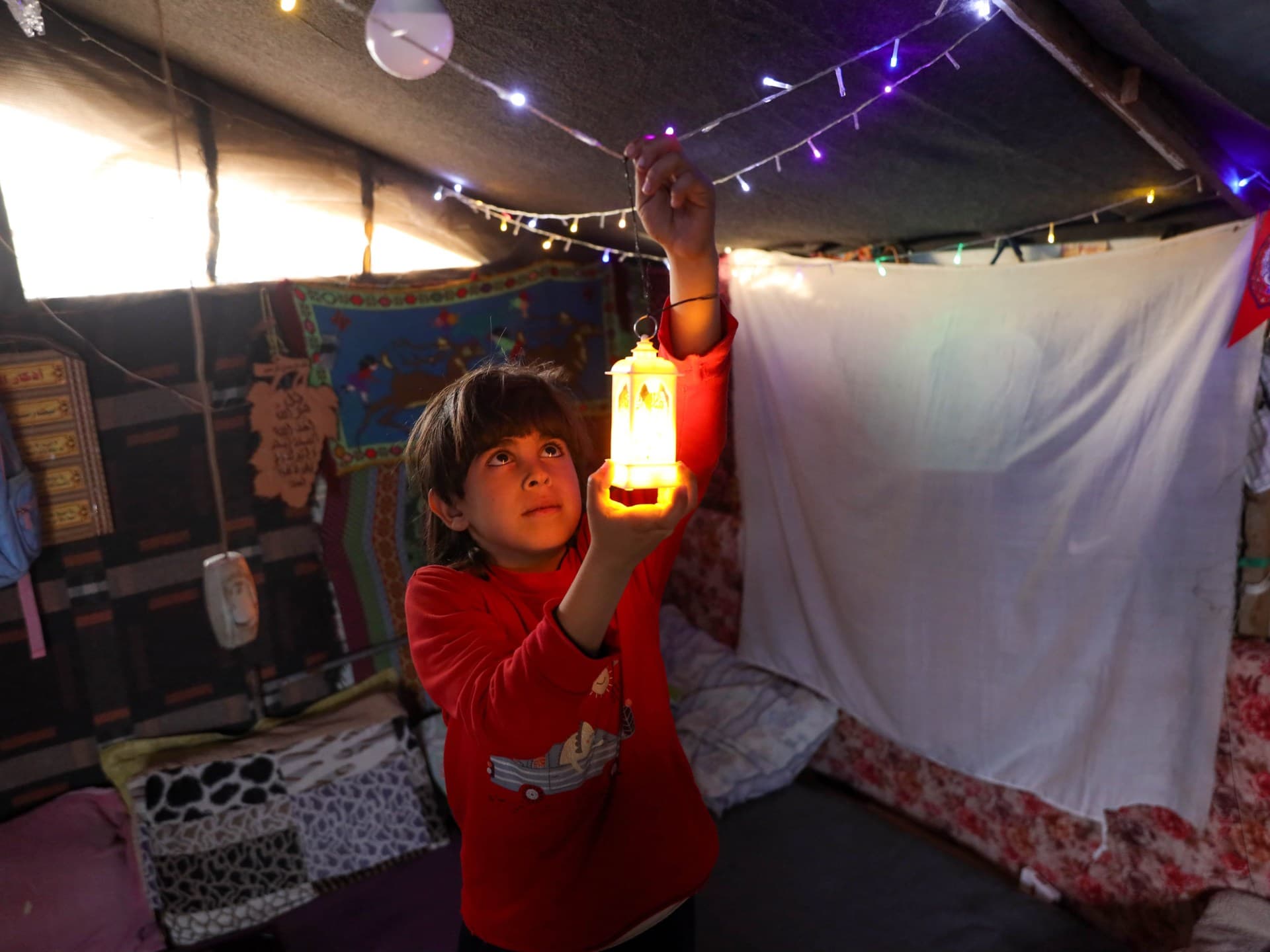
The call to prayer echoes across central Gaza, not from the minaret of a grand mosque, but through the rust-colored dust of the Bureij refugee camp. It weaves between tents patched with plastic sheets and walls scarred by shrapnel. Here, 52-year-old Maisoon al-Barbarawi—Umm Mohammed to her neighbors—hangs a small, battered Ramadan lantern from the worn ceiling of her family's tent. The simple decoration is an act of defiant hope. "We brought you decorations and a small lantern," she tells her nine-year-old son, Hasan, her smile strained with an exhaustion that has become a permanent resident.

*Maisoon al-Barbarawi's attempt to create a semblance of normalcy for her children in their tent in central Gaza. [Source: Al Jazeera]*
This is **Ramadan 2024 in Gaza**: a holy month of fasting and faith observed under the crushing weight of a five-month war and the **fragile silence of a six-week ceasefire**. The truce, brokered in Cairo with U.S., Qatari, and Egyptian mediation, has stopped the bombs but not the suffering. For the 1.7 million displaced Gazans—**roughly 75% of the population**—the ceasefire is not peace. It is a temporary, breathless pause, a moment to count the dead, dig through rubble for belongings, and scan a near-empty market for something, *anything*, to break the day's fast.
"My means are limited, but what matters is that the children feel happy," Maisoon says, her words a whisper against the roar of recent memory. The UN warns that **famine is 'almost inevitable'** without a massive, sustained influx of aid. In the camps, the price of a single egg can eclipse a day's wages. The traditional iftar feast of dates, soup, and spiced meats is a distant dream, replaced by handouts of canned beans and the dreaded 'mud bread,' made from animal feed. The spiritual reflection of Ramadan has been supplanted by a primal struggle for survival.
The ceasefire deal carries its own tense mechanics: the staged release of Israeli hostages held by Hamas for Palestinian prisoners in Israeli jails. Each exchange is met with public weeping on both sides, a reminder of the human cost that numbers cannot capture. Yet, this calibrated calm hangs by a thread. Israeli leadership has publicly **vowed to launch a military offensive in Rafah**, Gaza's southernmost city now crammed with over a million displaced souls, **once Ramadan concludes**. The threat casts a long shadow over every prayer, every shared date at sunset.
In a bombed-out mosque in Gaza City, worshippers pray amid cracked pillars and open sky. The communal spirit of *tarawih* prayers persists, but the congregation is a sea of weary faces, their *thobes* and hijabs dusted with the grit of destroyed homes. The anxiety is palpable, a silent question hanging in the air: *Will this be the last peaceful night?*
Back in her tent, Umm Mohammed smooths a child's drawing taped to the fabric wall. "I wanted these decorations to be a way out of the atmosphere of grief and sadness," she confesses. Her optimism is as fragile as the ceasefire itself—a small lantern fighting against an immense darkness. For Gaza, this Ramadan is not a celebration. It is an act of profound resilience, a fleeting moment of quiet in a long, painful story where the next chapter promises more storm.



 12:57
12:57 12:27
12:27 13:27
13:27 02:27
02:27 07:27
07:27